
What Weidian is
Weidian is a Chinese marketplace where individuals and small businesses run their own shops. Its own site sells the idea of opening a shop in a minute and running it through WeChat, which tells you who the customer is: the seller, not the shopper.
It is not a shopping agent. It does not act on your behalf, it does not inspect anything, and it has no English checkout. It is a place where sellers list, priced in yuan, shipped to Chinese addresses.
The practical consequence is simple. An overseas buyer may need an agent when the seller or checkout cannot accept their payment or deliver internationally. Somebody inside China has to buy it, receive it, and send it on.
Why Weidian, and not another marketplace
Fair question, because the same agent buys from Taobao, Tmall, 1688 and Xianyu too, and plenty of finds on the spreadsheet come from those.
Weidian listings tend to be small independent shops rather than large storefronts. That cuts both ways. You often get sellers who specialise narrowly and answer questions in detail, and you also get shops that go quiet for a week. Compared with 1688, which is built for wholesale and thinks in cartons, a Weidian listing is usually happy to sell you one of something.
If the same item appears on two marketplaces at a similar price, there is no prize for insisting on Weidian. Pick whichever listing is clearer about size, material and what is actually in the box.
What a shopping agent actually does for you
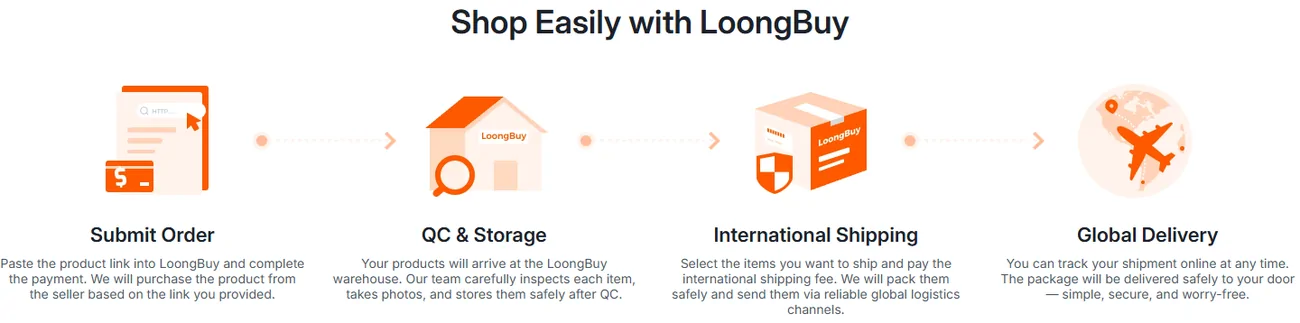
A shopping agent is a company inside China that buys on your behalf, receives the parcel at its own warehouse, and forwards it to your country. The agent this guide points at publishes its trip as four steps.

Submit the order
You paste the listing link, choose the seller own options, and pay for the item plus domestic delivery.
Inspection and storage
The warehouse receives it, checks it against its published inspection standard, and holds it while you decide what else to add.
International shipping
You choose a line and pay freight when you submit the parcel, not when you buy the item.
Delivery
A local courier finishes the trip. Customs treatment depends on your country, not on the agent.
Why LoongBuy, and when to use something else
Start with the part nobody advertises: on the things beginners worry about most, agents are far more alike than the comparison posts suggest. Nearly all of them buy from the same marketplaces, photograph parcels on arrival, hold goods free for a period, and offer several freight lines at prices set by the couriers rather than by them.
What is genuinely specific to this one: it names Weidian in its own site title as a supported source, it publishes a freight estimate tool you can use before signing up, and its own home page carries a running list of logistics notices, which is unusually candid about routes being suspended.
Reasonable reasons to use it
- You want Weidian, Taobao, 1688 and Xianyu handled by one account
- You want a freight estimate before committing to anything
- You would rather read logistics notices than discover a suspended route at checkout
Reasons to use somebody else
- You already have an agent account with items sitting in its warehouse: moving mid parcel costs more than it saves
- You need a service this one does not run in your country
- You need to read the relevant policies before opening an account; check that access before choosing an agent
Checked on site
Check policy access before ordering
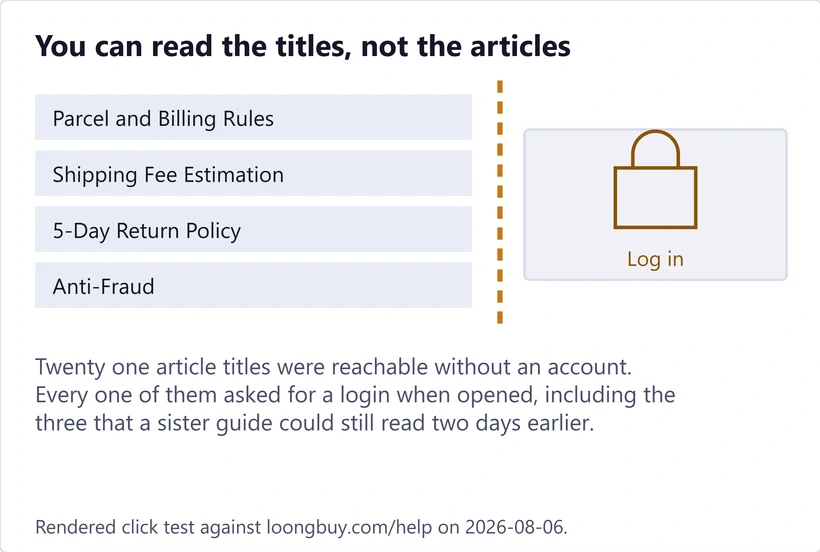
This is worth knowing before you need it. On 2026-08-06 we clicked through the agent help centre without an account. The ten section names are public. The article titles under them are public: Parcel and Billing Rules, Shipping Fee Estimation, 5-Day Return Policy, Anti-Fraud and about seventeen others.
In that 6 August check, all twenty-one opened articles redirected to sign-in. This records the access observed then; it does not establish today’s access rules.
Open the current help centre before deciding. If an article requires sign-in, read it from your account or ask support for the applicable rule before spending money. We link the help centre index so you can find the current article and access requirements.
What to do first, in order
Nothing here needs an account except the last one, which is the point.
Browse before you register
Routes and search are open to everyone. Build a shortlist first, so your first logged in hour is spent ordering rather than looking.
Try the freight estimate
The agent estimate page takes a destination, a weight and dimensions. Rough numbers early beat a surprise at parcel submission.
Open the estimate toolAgent siteThen open the account
Registration is where sizes, colours and messages to sellers happen. Our link carries a referral code, which is how this guide is funded.
Register with the agentKnow where help lives
Support channels, what the catalogue can and cannot answer, and the questions people ask most.
Help and FAQWhy go through an agent at all
A Weidian seller ships inside China. That is not a limitation anyone is hiding; it is what the shop was built to do. The gap between that shop and your door is the whole reason a middle step exists.
The agent fills it with four jobs, and it publishes them as four steps on its own front page: it buys the item in its own name, it checks and photographs what arrives, it holds the goods until you say go, and it puts them on a plane. You pay it, it pays the seller. Your account, your refund rights and your parcel all live on that side.
Which also tells you when not to bother. If a seller already ships to your country and you are buying one light thing, the middle step adds a fee and a wait for nothing.
Comparing agents without a ranking
This guide points at one agent, and says so on every page. That is a commercial relationship, not a verdict, so here is the honest version: five things you can read yourself before you trust any of them.
We do not publish a league table. The things that would decide one, service quality and the odds of an order going wrong, have no public measurement behind them, and a number invented for a table is still invented.

| What to look at | Why it decides something |
|---|---|
| Does it take Weidian links at all | Not every agent does. The ones that do usually print a strip of marketplace icons somewhere on the front page. If Weidian is not in that strip, nothing else about the agent matters for this catalogue. |
| What it charges on top | A service fee, a fee of zero, or a fee folded into the exchange rate. All three exist. The number to find is not the headline, it is what you are charged when the goods reach the warehouse. |
| What the free check covers | Every agent photographs. Not every agent opens a sealed box, and almost none test that a thing works. The scope is written down somewhere; find it before you need it. |
| How long it will hold goods | The storage clock decides whether you can buy across several weeks and ship once. It is a number on a page, not a matter of opinion. |
| Which routes serve your country | The route list is the part people check last and regret first. Liquids, batteries and anything heavy narrow it fast. |
Read the table as four situations rather than a score sheet. If you want one parcel built up over several weeks, look at the storage clock before anything else, because that single number decides whether the plan is possible. If you want the cheapest total on one light item, look at the exchange rate and the freight quote together, since a headline fee of zero can still lose to a better rate. If you want a heavy or awkward thing moved, look at the route list first, because it decides what is even allowed to fly. And if you want to buy from Weidian specifically, look for that marketplace strip: an agent that does not take Weidian links cannot help you here whatever else it does well.
The exchange rate is a step, not a footnote
Every price on a card is in Chinese yuan. Nothing on this site converts it for you, and that is deliberate: the rate that decides your bill is the one applied at the moment your payment clears, by whoever takes the money.
So the yuan figure is a starting point with three things still to happen to it. The platform converts at its own rate, which is usually a little worse than the mid market rate you get from a search engine. Your card or wallet may convert again if it is not holding the same currency. And the second payment, the freight, is quoted separately and converts on its own day.
The useful habit is to decide in yuan. Compare two listings in yuan, decide in yuan, and convert once at the end to sanity check the total. Converting every line as you browse makes a slow decision out of an easy one, and the number you worked out will have moved by checkout anyway.
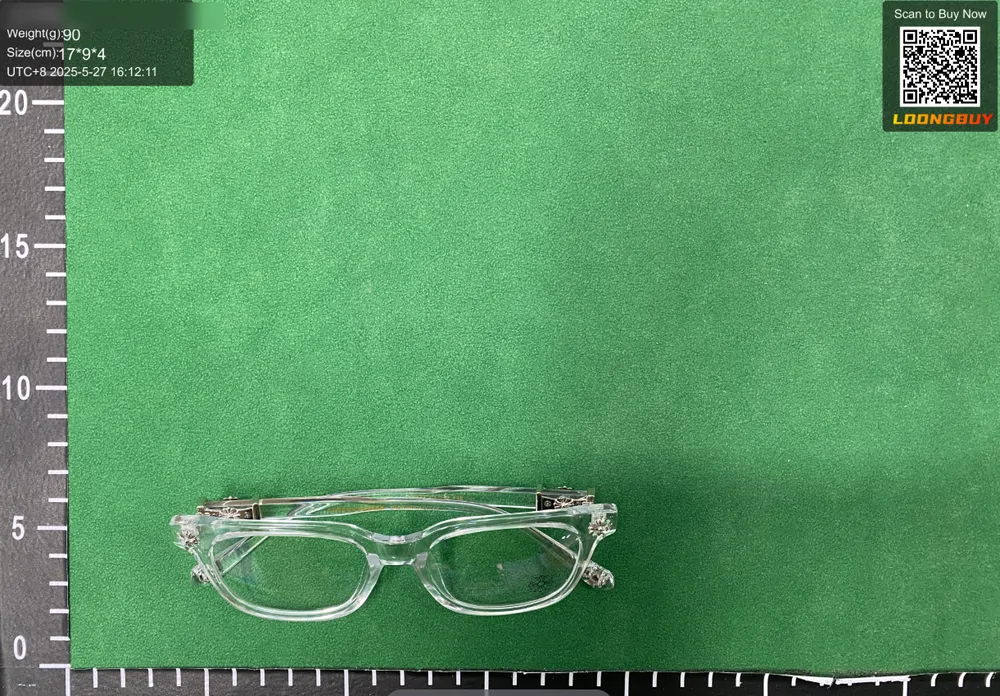
How to read the QC photos you are sent
The check happens after the agent receives the goods and before you pay to ship them. It is the one moment where a problem is still cheap, so it is worth five minutes rather than a glance.
Look at the things a photograph can settle and ignore the things it cannot. Count the pieces. Compare the colour against the option you selected rather than against the listing photograph, which was lit to sell. Read any label in the frame, because the size on the label is what the warehouse checked against. Look along seams, sole edges and hardware, where the differences between two listings of the same thing usually show.
What a photograph cannot settle is whether an electronic item works, whether a sealed box holds everything it should, or whether a material is what the title claimed. If that is the part you care about, ask before you submit the parcel. Afterwards it is in the air and the conversation changes.
Compare agents on six practical questions
LoongBuy, Superbuy and ACBuy are examples of the services a Weidian buyer may compare. Use each official site to check the same source link and destination; a familiar brand name does not replace these checks.
| Dimension | What to verify before paying |
|---|---|
| Fees | Add the item, domestic delivery, conversion and payment charges, optional warehouse services, freight and destination charges. |
| Routes | Check the exact product category and destination in the current estimator. A broad country list does not establish eligibility. |
| Speed | Separate seller dispatch, warehouse processing and carrier transit. Ask which stage a quoted estimate includes. |
| Service | Find the order support route and ask a specific question about the option or inspection you need. |
| Handling | Read the QC scope, packing choices and restricted-item policy. Decide whether the available photos answer your concerns. |
| Trust | Verify the official domain and operator, withdrawal terms, claim process, compensation limits and storage expiry rules. |
Choose for the order you actually have
For several sellers, compare consolidation and storage terms. For an urgent purchase, compare the complete timeline rather than transit alone. For an unusual item, verify acceptance and protection before considering price.
Fees, shipping and the two payments
At purchase you pay the seller’s item price, domestic delivery and applicable transaction charges. At parcel submission you pay international freight plus any selected packing or protection service. Paid storage or extra services can add costs between those steps.
Read the estimator’s units and weight rule. Some lines compare measured weight with a value calculated from length, width and height. Use the chosen carrier’s formula rather than assuming one divisor applies to every line.
Taxes, duties and handling depend on the destination and shipping terms. Review the current official rules for the contents and declared value; another buyer’s parcel is not a quote for yours. Track the parcel after dispatch and keep the order and photos until delivery is resolved.