The mistakes that cost time, in the order they happen
None of these are about taste. They are structural: the catalogue is organised in a way that makes a few specific wrong turns very easy to take, and each one wastes an evening in a slightly different way.
The first two are the reason this guide exists. The rest come up often enough in messages that they belong in one place.
1. Entering through an umbrella word
Shoes, Apparel, Accessories, Bags and five more sound like front doors and hold almost nothing. The page loads, the name is right, a few real products show up, and nothing tells you that you are seeing a fraction of the shelf. This is the single most expensive wrong turn on the spreadsheet.
Instead: Open the specific route instead. The map lists all nine umbrella words with what to open in their place.
2. Typing a route address by hand
Route names and route addresses do not always match. Dolls lives at /c/plush-toys. Face Masks lives at /c/face-mask. There is even a genuine typo in the catalogue, where the route displayed as Other lives at a misspelled address. Guessing addresses lands you on nothing and feels like the route was removed.
Instead: Open routes from the map or the router and the address is handled for you.
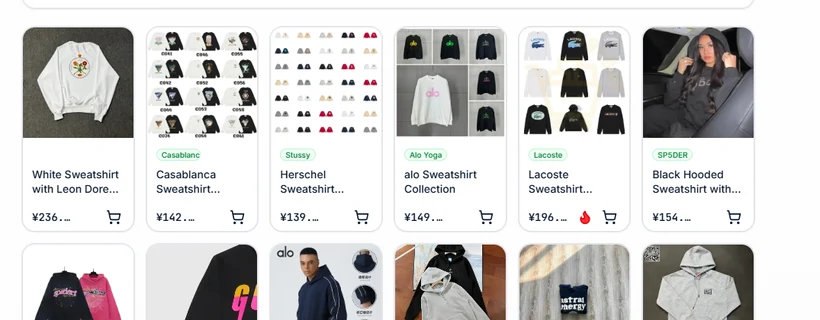
3. Treating the card photo as evidence
The photo on a card belongs to the seller and was chosen to sell. It is not an inspection photo, it is not necessarily the unit that will be picked, and on collection listings it is often the most flattering variant of several.
Instead: Read the title, which is translated from the seller wording and usually carries the details that matter. Photographs that mean anything come after purchase.
4. Reading the yuan price as the landed price
A card price is the item inside China. Service fee, domestic delivery, international freight and any import charges all arrive later. On light items freight can exceed the item. On bulky ones like a padded jacket it usually does.
Instead: Get a rough freight number early. The agent publishes an estimate tool that takes destination, weight and dimensions before you commit to anything.
5. Trying to check out on the marketplace itself
Weidian is built for buyers inside China. Prices are in yuan, checkout expects Chinese payment, delivery expects a Chinese address. People burn an evening trying to make an account work and conclude the item is unavailable.
Instead: The listing link is what you need, not the checkout. Paste it into the agent, which buys on your behalf.
6. Asking the catalogue about a parcel
The catalogue never had your order. It cannot see it, change it, cancel it or refund it, so an email here about a delayed parcel costs you a day before you ask the party that can act.
Instead: Order questions go to the agent account. Catalogue questions, like a route looking stale or a card pointing at a dead listing, come to us.
7. Making the first order a big one
The first order is a test of an agent, a freight line and your own customs treatment, and none of those are knowable in advance from reading. A large first parcel puts all of that risk in one shipment.
Instead: Send one light item through the whole trip first. Then scale up with a picture of how long it took and what it cost.
Two that are not mistakes
Worth saying, because people apologise for both.
Taking a week to decide
Browsing slowly is fine. The only cost is that a specific listing may go, and on big routes there is usually a near identical one.
Asking the seller something obvious
Questions about size, material and what is in the box are normal and go through the agent. A seller who does not answer is itself useful information.
Where to ask whatWarning signs worth taking seriously
Most things that go wrong on this route are ordinary: a wrong size, a slow week, a parcel that sits. The rarer kind, where money leaves and nothing arrives, tends to announce itself in advance if you know what to read.
| Signal | What it usually means |
|---|---|
| Nothing has a date on it | A page that never says when it was last touched is asking for trust it has not earned. Dated notices are the cheapest signal there is. |
| The terms are prose, not numbers | Storage, compensation and inspection either have figures attached or they do not. Warm wording with no number is a promise nobody has to keep. |
| You cannot find who runs it | A company name, a registration, an address. One search should settle it. If it does not, every other question gets harder later. |
| Support only exists in one direction | A form that sends and never replies is not a support channel. Look for a route where a human has to answer, and for evidence that one has. |
| The price quoted is the only price mentioned | Goods, domestic delivery, freight, customs. Four numbers. Anywhere that mentions one of them and goes quiet about the rest is selling, not explaining. |
Weidian traps that catch people who arrive by link
The shop closed and the link did not. Small shops open and shut constantly. A link that worked when somebody posted it can land on an empty page months later, and the page will not say why.
The listing is one of several identical ones. The same photograph appears across several shops at different prices. Cheapest is not automatically the same item, and it is not automatically a worse one either. Judge the listing, not the position in a list.
Options matter more than the title. Colour and size are chosen on the page in Chinese, and the title often describes only one of the variants. Select carefully, and say in the order note what you meant.
Stock is a moment, not a state. Nothing reserves an item until the agent actually buys it, so a long gap between finding and ordering is the single most common reason a find evaporates.